
Nordic Walking for Upper Body Functional Strength
Discover how Nordic walking builds upper body functional strength while improving posture, endurance, and full-body coordination. Learn why this low-impact workout delivers more benefits than regular walking.
FUNCTIONAL HEALTH
2/15/20263 min read

Introduction
Most people think of walking as a lower-body activity. But Nordic walking transforms a simple walk into a full-body functional workout - especially for the upper body.
By using specially designed poles, Nordic walking activates the arms, shoulders, chest, core, and back while maintaining the low-impact benefits of traditional walking. The result? A powerful combination of cardiovascular conditioning and upper body functional strength.
Let’s break down why this underrated movement deserves serious attention.
What Is Nordic Walking?
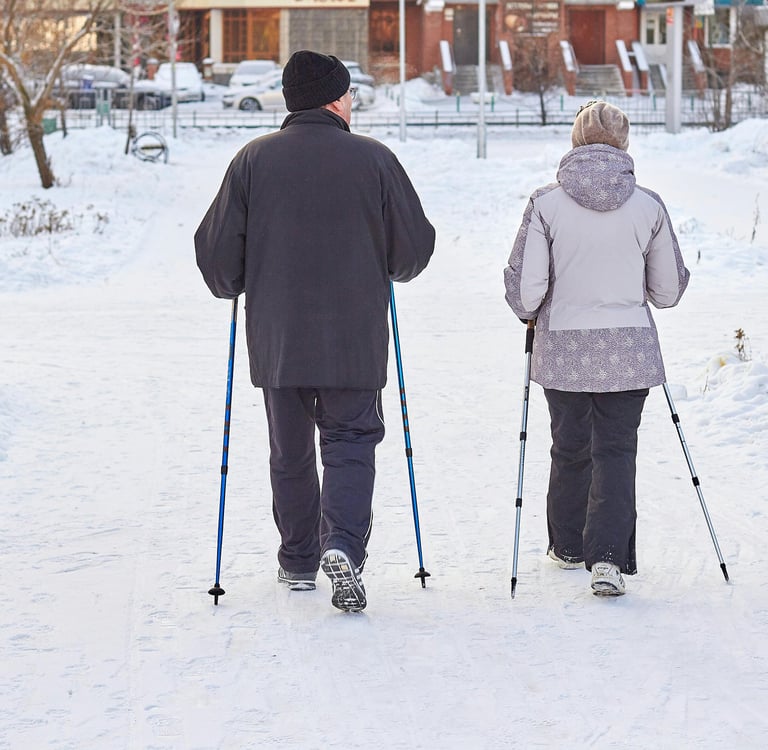
Nordic walking originated in Finland as off-season training for cross-country skiers. It involves walking with poles that are planted behind the body and pushed through each stride in a coordinated, rhythmic motion.
Unlike casual trekking poles used for stability, Nordic walking poles are actively engaged with each step, creating propulsion through the upper body.
This technique increases muscle activation and energy expenditure compared to regular walking - without adding joint stress.
How Nordic Walking Builds Upper Body Functional Strength
Functional strength refers to strength that improves real-world movement - pushing, pulling, rotating, stabilizing, and carrying.
Nordic walking enhances these patterns because each step involves a coordinated upper-body push through the pole. This movement activates:
Triceps (during pole push-off)
Shoulders (especially posterior deltoids)
Latissimus dorsi (back muscles involved in pulling)
Core stabilizers (to maintain posture and rotation control)
Chest muscles (through forward arm drive)
Unlike isolated gym exercises, Nordic walking trains these muscles dynamically while you move - making it highly transferable to everyday activities.
The repetitive push-through motion essentially turns your walk into hundreds of light resistance repetitions.
Why It’s Superior to Regular Walking for Strength
Traditional walking primarily targets the lower body - glutes, hamstrings, calves, and hip flexors. Nordic walking increases muscle engagement by up to 80–90% more in the upper body compared to standard walking.
This added activation delivers several benefits:
Increased calorie burn
Improved posture and spinal alignment
Enhanced shoulder mobility
Greater muscular endurance
Balanced full-body conditioning
It’s particularly valuable for people who sit for long hours and develop rounded shoulders or upper-back weakness.
Functional Fitness Benefits Beyond Muscle
Nordic walking isn’t just about arm strength - it supports total-body function.
The pole drive encourages upright posture, reducing forward head positioning common in sedentary individuals. The rotational arm swing improves coordination and gait efficiency. Because it distributes effort across both upper and lower body, it can also reduce joint load in the knees and hips.
For aging populations, Nordic walking can enhance balance, stability, and fall prevention. For athletes, it serves as a powerful active recovery tool that maintains upper-body engagement without overloading joints.
How to Do Nordic Walking Correctly
Technique matters. The key difference between Nordic walking and hiking with poles is propulsion.
Here’s what proper form includes:
Poles angled backward, not vertically planted
Push through the strap using the palm
Open your hand briefly at the back of the stride
Maintain upright posture with relaxed shoulders
Keep a natural heel-to-toe gait
The arm motion should feel like a powerful cross-country ski movement rather than a simple plant-and-step pattern.
Mastering technique maximizes upper body activation and functional carryover.
Who Should Try Nordic Walking?
Nordic walking is ideal for:
Beginners looking for low-impact strength training
Adults over 40 aiming to preserve muscle mass
Individuals recovering from injury who need joint-friendly movement
Outdoor fitness enthusiasts
Functional fitness practitioners
It offers a scalable way to build endurance and strength simultaneously without needing a gym.
How to Progress Nordic Walking for Strength Gains
If you want to increase the upper-body challenge:
Walk on inclines
Increase pace while maintaining form
Use interval bursts of faster pole drive
Add a weighted vest for advanced progression
Focus on exaggerated push-off during each stride
Consistency is key. Even 30–45 minutes, 3–4 times per week, can significantly improve upper-body endurance and posture over time.
Conclusion
Nordic walking is far more than a walking variation - it’s a full-body functional fitness tool hiding in plain sight.
By incorporating pole propulsion, you engage your arms, back, shoulders, and core while maintaining the joint-friendly benefits of walking. The result is improved posture, endurance, balance, and upper body functional strength - all from a simple, accessible movement.
If you’re looking for a sustainable way to build strength outdoors without heavy lifting, Nordic walking may be one of the smartest training upgrades you can make..
Connect with us
Get in touch with us for questions or collaboration inquiries.
Contact
Editorial & general inquiries:
info@nodrae.com
NODRAE
An independent wellness publication exploring longevity, nutrition, and lifestyle factors that support long-term health.
Our content is research-informed and created for informational purposes only.
© 2026 nodrae.com. All rights reserved.